 EN

Stretch Lace Trim by the Yard: A Wholesale Sourcing Checklist
Buying stretch lace trim by the yard for a wholesale program sounds straightforward until design, sourcing, and production teams use different definitions of “stretch,” “soft,” or “ready for bulk.” For apparel brands, garment processors, and wholesalers, the safer approach is to turn those words into a written specification and a sample-review plan before a purchase order is released.
This checklist is designed for buyers sourcing decorative elastic lace for womenswear, childrenswear, lingerie-inspired details, overlays, and coordinated garment ranges. It focuses on questions a supplier can verify—not assumptions based on a photo or a product name. That matters because lace-trim selection involves visual effect, construction, handling, and the intended garment all at once.
Start With the Intended Use, Not Just the Look
A search for stretch lace trim by the yard can surface both retail fabric listings and general textile information. Wholesale buyers need a narrower brief. Before comparing quotes, state whether the trim will be used as an edge finish, an insert, a waistband-style detail, a sleeve accent, or a layered decorative element. The same motif can behave differently once it is sewn into a garment and paired with a lining or elastic construction.
Include these use-case notes in the RFQ:
- garment category and target wearer;
- the trim’s placement and expected stretch direction;
- whether the trim will touch skin, sit over a lining, or be used as an exposed overlay;
- the desired visual density, motif scale, and color reference; and
- the stage at which your team will approve the material: swatch, lab-dip, development sample, or pre-production sample.
These details help prevent a common sourcing problem: selecting an attractive lace before confirming whether its scale, openness, or recovery suits the garment panel.
Confirm the Material Construction and Elastic Behavior
“Stretch” is a selection clue, not a complete specification. Buyers should ask for the fiber composition, the base construction, the direction of stretch, and the method used to assess recovery. Industry buying guidance commonly treats the presence of an elastic fiber such as spandex or elastane as something to confirm directly; it should not be inferred from the listing name alone.
For lace trim by the yard wholesale inquiries, ask the supplier to identify what is confirmed and what still needs sampling. Useful fields include:
| Specification area | What to request | Why it matters |
|---|---|---|
| Composition | Fiber-content statement for the lace and elastic component | Keeps material language consistent across sourcing and product teams |
| Width | Nominal width plus the allowed tolerance | Separates narrow edging from wider decorative lace applications |
| Stretch direction | Lengthwise, crosswise, or both; ask for a physical sample | Supports correct placement and pattern planning |
| Recovery | How the supplier recommends checking return after extension | Helps the team compare options on the same basis |
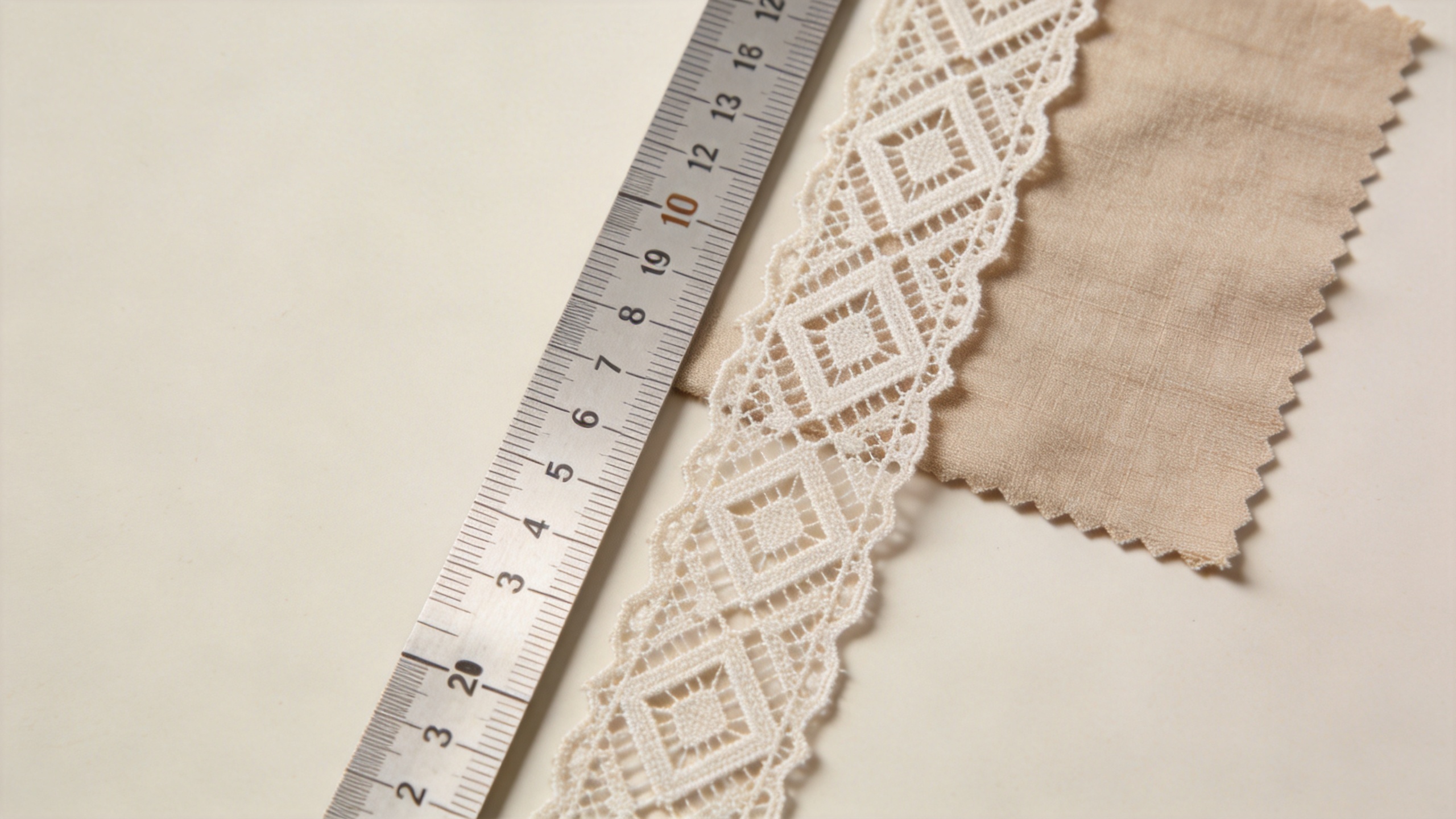
| Motif repeat | Repeat information and a close-up image or sample | Reduces surprises at seams, panels, and garment edges |
Do not turn missing information into a performance claim. If recovery, colorfastness, weight, or finishing details are not documented, mark them as pending verification and include them in the sample brief.
Evaluate Width, Motif, and Transparency as One Decision
In a stretch lace trim by the yard program, width alone does not tell you how a trim will read on a finished garment. A narrow trim may function as edging, while a broader lace construction may require different cutting, seaming, or lining decisions. Motif scale also changes the perceived proportion of a sleeve, neckline, hem, or panel.
Review samples in the same way the end garment will be viewed. Place the lace over the proposed lining or base fabric, inspect it under normal working light, and assess a close-up alongside a full garment-scale mock-up. This is especially useful when the lace has an open mesh base: transparency is influenced by the layer beneath it, not by the lace alone.
Questions for a practical sample review
- Does the motif sit cleanly at the planned edge or seam?
- Does the trim retain the intended visual balance after it is gently extended?
- Are there areas where the base net needs a different lining approach?
- Can the repeat be placed consistently across the size range?
- Has the team documented what is an aesthetic preference versus a production requirement?
Build a Supplier-Ready RFQ for Wholesale Orders
For lace trim by the yard wholesale sourcing, an RFQ should make it easy for a supplier to quote the same request your internal team is reviewing. Include the expected order unit, target quantity, sample quantity, required delivery timing, destination market, and packing preferences. Then attach a visual reference and a numbered list of open questions.
A useful RFQ can distinguish three columns: confirmed requirement, supplier to confirm, and sample approval point. This structure is more reliable than asking whether a lace is simply “high quality,” because it directs the discussion to observable conditions.
For a product starting point, buyers can review the available Factory Supplier Stretch Lace Nylon Spandex Skin-friendly Geometric Lace page and use it to begin a specification conversation. The page title identifies a stretch lace construction; composition, dimensions, performance expectations, minimum order details, and final application suitability should still be confirmed directly with the supplier before bulk commitment.
Use Samples to Align Design, Sourcing, and Production
A wholesale decision is stronger when every stakeholder is reviewing the same questions. Designers may focus on motif and drape, sourcing teams may need quote comparability, and production teams may need panel-placement clarity. A short sample-review form creates a shared record instead of relying on informal comments.
For each option of stretch lace trim by the yard, record the sample ID, supplier, color reference, width, claimed composition, stretch direction, intended garment use, and decision status. Add a field for unresolved questions. This makes it easier to compare later samples without treating an older note as a confirmed specification.
Final Wholesale Checklist Before You Place an Order
- Define the garment use and trim placement.
- Confirm fiber composition and elastic content in writing.
- Specify width, direction of stretch, motif repeat, and color reference.
- Request samples that reflect the actual lining and construction plan.
- Review extension and recovery with a documented internal method.
- List quantity, order unit, delivery needs, packing, and destination market in the RFQ.
- Separate approved facts from items still awaiting supplier confirmation.
- Approve the bulk reference against the same criteria used for the sample.
When sourcing teams use this checklist, stretch lace trim by the yard becomes a clearer procurement brief rather than a broad visual search. The result is not a promise that every lace will suit every garment; it is a more disciplined way to ask the right questions, compare options fairly, and move toward a bulk decision with fewer unknowns.