 EN

How to Source Bulk Lace Trim for Apparel Production
Buying bulk lace trim for a production line is not the same as buying a few rolls for a sample room. A trim that looks right on a swatch can create cutting loss, sewing delays, shade variation, or replenishment trouble once it reaches a factory floor. For womenswear, childrenswear, and fashion-brand programs, the practical goal is to turn a visual choice into a repeatable specification.
This guide is written from a sourcing perspective for overseas apparel buyers. It explains how to compare bulk lace trim, what to ask before approving a supplier, and how to make a first order easier to repeat. The aim is not to declare one lace universally better than another; it is to help your team define the version that fits the garment, sewing process, and order plan.
Start With the Garment Function, Not the Lace Photo
The first decision for bulk lace trim is where it will sit on the garment. A neckline insert, sleeve edge, lingerie elastic, hem border, and decorative overlay face different tension, abrasion, and wash conditions. Begin the sourcing brief with the garment type, attachment location, season, intended care method, and whether the trim must stretch with the base fabric.
For example, a stretch application may require buyers to assess composition, stretch direction, recovery, edge stability, and how the lace behaves after stitching. A non-stretch decorative border may instead prioritize pattern definition, drape, width tolerance, and clean cutting. This early distinction avoids a common bulk lace trim mistake: comparing samples only by appearance while leaving the performance requirement unspoken.
- State the end garment and the trim placement.
- Specify whether stretch and recovery are required.
- Share the shell fabric or a representative swatch for compatibility testing.
- Clarify whether the trim will be cut, gathered, folded, or sewn flat.
Build a Purchase Specification That Can Be Quoted
A useful bulk lace trim inquiry gives suppliers enough detail to quote the same requirement rather than offering loosely comparable alternatives. Put visual reference photos beside measurable requirements. At minimum, request the lace construction or material description, usable width, pattern repeat, color reference, roll length, packaging preference, and target quantity by color.
Ask the supplier to confirm the actual order basis: meters, yards, rolls, or kilograms. This matters especially when comparing lace trim by the yard wholesale offers. A unit price can look attractive while roll length, usable width, or expected cutting yield differs from the comparison item. For repeat programs, identify whether the pattern, color, and base material are stock-supported or need a new production arrangement.
| Specification area | Questions to include in the RFQ |
|---|---|
| Material | What fiber content and construction are proposed? Is the lace stretch or non-stretch? |
| Dimensions | What are the nominal and usable widths, repeat, and tolerance? |
| Color | Which shade reference will govern approval, and how will lots be identified? |
| Order format | How many meters or yards per roll, and how are rolls labeled and packed? |
| Production control | What sample, pre-production approval, and inspection points can be agreed? |
Evaluate Samples as a Production Test
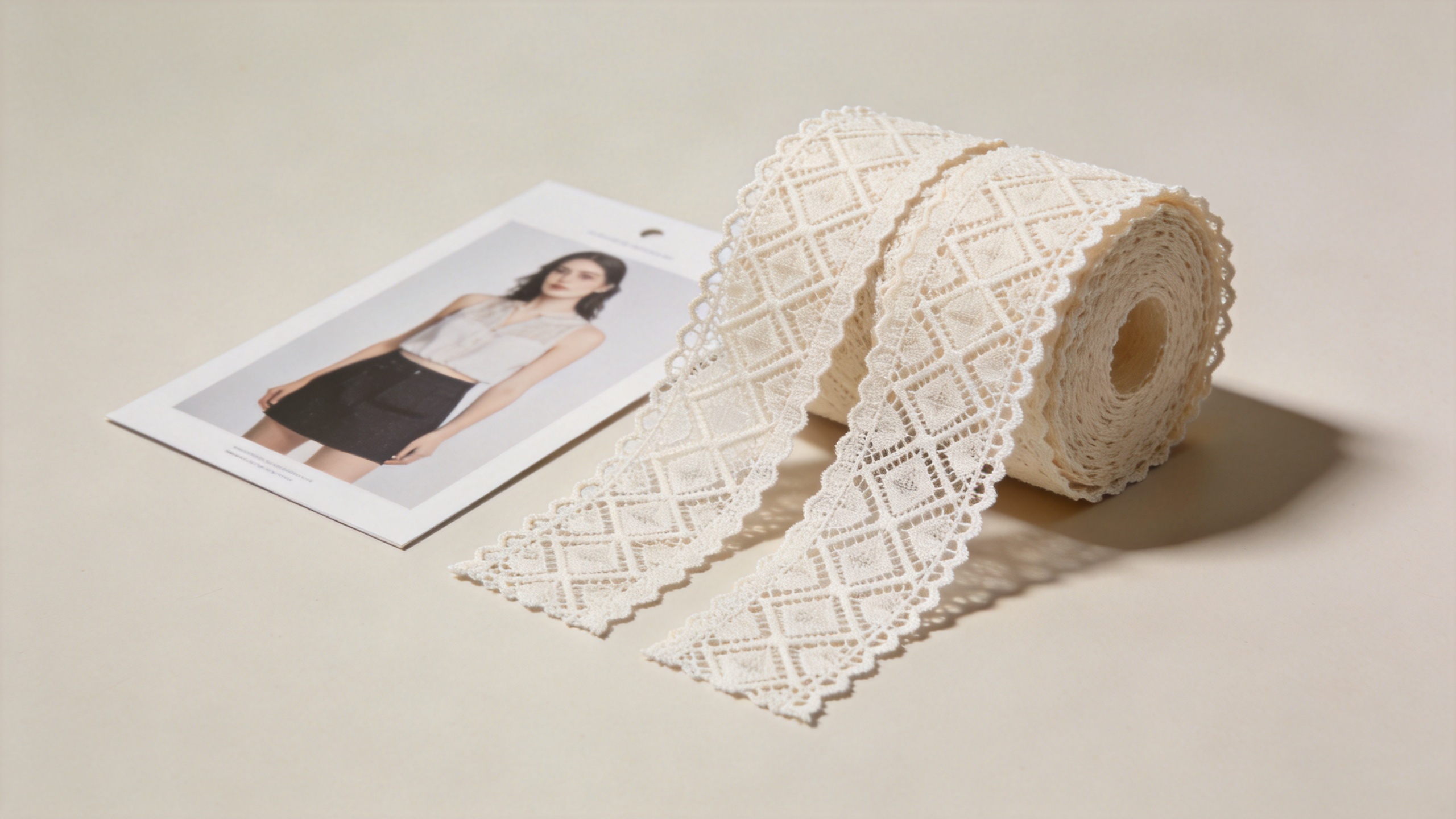
Do not approve bulk lace trim from a photograph alone. Request a representative cutting or sample length, then test it with the actual garment fabric, thread, stitch type, and machine settings whenever possible. The point is to expose issues that a flat sample cannot show: curled edges, skipped stitches, uneven gathering, distortion at corners, or a pattern that does not align cleanly across panels.
During evaluation, record observations instead of relying on memory. Production-oriented lace guides commonly focus their inspection on pattern consistency, width, color, stretch and recovery where relevant, dimensional stability, and visible surface defects. Turn those areas into an approval checklist for your selected bulk lace trim. If the design is sensitive to continuity, also define what constitutes an acceptable join, flaw, or short roll.
Compare at least two versions of the same bulk lace trim when the garment margin or production volume is meaningful. The lowest material price is only one input. A slightly different construction may reduce sewing difficulty, cutting waste, or later claims. Ask the sample room to note time-consuming handling issues before the commercial team finalizes the order.
Check Supplier Readiness for a Repeat Order
For apparel production, a bulk lace trim supplier should be evaluated on communication and traceability as well as on the sample itself. Ask who will confirm the final specification, how revisions are documented, and whether the supplier can identify the production lot on labels and shipping documents. These details make a difference if a brand needs a replenishment order months after the first delivery.
MOQ is another point to clarify early. Online guidance may cite lower quantities for stock-supported trims, but the achievable minimum depends on the design, color, material, machine route, and current inventory. Treat every MOQ as a supplier-specific quotation. For each bulk lace trim option, ask separately about sample MOQ, production MOQ, color MOQ, and the conditions for reorder continuity.
Shaoxing Huace Textile Co., Ltd. positions its range around lace fabrics, mesh designs, trimmings, and bespoke lace patterns. If your brief calls for a stretch geometric option, review the available Factory Supplier Stretch Lace Nylon Spandex Skin-friendly Geometric Lace against your own composition, stretch, and application requirements rather than assuming suitability from its name alone.
Use a Pre-Order Checklist Before Placing Bulk Lace Trim
Before issuing a purchase order for bulk lace trim, bring merchandising, technical, quality, and logistics questions into one written confirmation. This prevents a buyer from approving a look while production is still missing the information needed to receive and use the material.
- Confirm the approved sample or signed specification reference.
- Confirm fiber content, construction, width, pattern, and color standard.
- Agree quantity, unit of measure, roll length, packing, and permitted tolerance.
- Define inspection points, defect handling, lot marking, and claim communication.
- Confirm production timing, shipping plan, and reorder expectations.
A disciplined bulk lace trim process does not remove every variation inherent in textile production. It does give both buyer and supplier a shared reference for decisions. That makes it easier to compare quotations fairly, approve the right sample, and place a bulk order that supports consistent apparel production.