 EN

How to Choose Stretch Lace Trim for Lingerie Manufacturing
For an intimatewear collection, stretch lace trim is more than a decorative finish. It can influence how a bra edge lies against the body, how a brief moves through repeated wear, and how consistently a production line handles cutting and sewing. For lingerie manufacturers and sourcing teams, the right choice comes from matching the lace construction to a defined garment zone—not from choosing a pattern alone.
This guide takes a practical, comparison-led approach to stretch lace trim. It focuses on material composition, stretch behavior, width, edge design, sampling, and supplier communication. The aim is to help a buyer turn an attractive swatch into a trim specification that can be tested on a real garment.
Start with the garment zone and its job
Before comparing colors or motifs, identify where the stretch lace trim will be used. A neckline, leg opening, underband overlay, side panel, and decorative strap all place different demands on the material. A narrow edge needs controlled elongation so it follows the curve without rippling. A wider decorative band may need visual coverage and a softer hand while still recovering after extension.
Build the brief around the garment’s function. For example, a trim at a brief leg opening needs to work with the elastic behavior of the surrounding fabric and sewing method. A scalloped neckline trim needs a clean visual edge and enough recovery to avoid standing away from the body. For a fashion bralette, appearance may be the first priority; for a high-volume core style, repeatability across lots deserves equal weight.
Compare fiber composition and hand feel
Most stretch lace trim combines a decorative ground yarn with an elastic component. Nylon, polyester, cotton, and elastane-based blends can all appear in the category, but they do not feel or behave the same. The base fiber influences surface character, softness, sheen, dye response, and abrasion behavior; the elastic component contributes extension and recovery. A search-based market reference describes many stretch-lace constructions as using a base fiber with roughly 5–20% spandex or Lycra, but this is only an orientation point. The actual composition and performance must be confirmed in the supplier’s specification.
Ask for a physical hand-feel comparison rather than relying on a composition label. Place samples against the intended lining, mesh, microfiber, or knit. Check whether the lace feels scratchy at the scallop, whether it snags easily, and whether it creates an unwanted contrast in sheen. When comfort is central to the style, test the sample on the body-facing side of the garment, not only on a flat cutting table.
Measure stretch in the direction you will use it
“Elastic” is not a complete specification. A stretch lace trim may extend differently across its width and along its length. The production team should mark the intended direction of stretch on the sample and compare it with the pattern direction. If the orientation is reversed during cutting, a trim that looked correct during development can become difficult to sew or can distort the finished edge.
For each candidate, record a simple sample-test routine: starting length, extension under the agreed hand force or test method, recovery after release, and appearance after several extension cycles. Look for permanent growth, curling, broken yarns, loss of scallop definition, or uneven return. A good result is not necessarily the highest stretch percentage. It is the behavior that gives the garment the intended fit while remaining stable in the construction process.
Select width and edge geometry for the construction
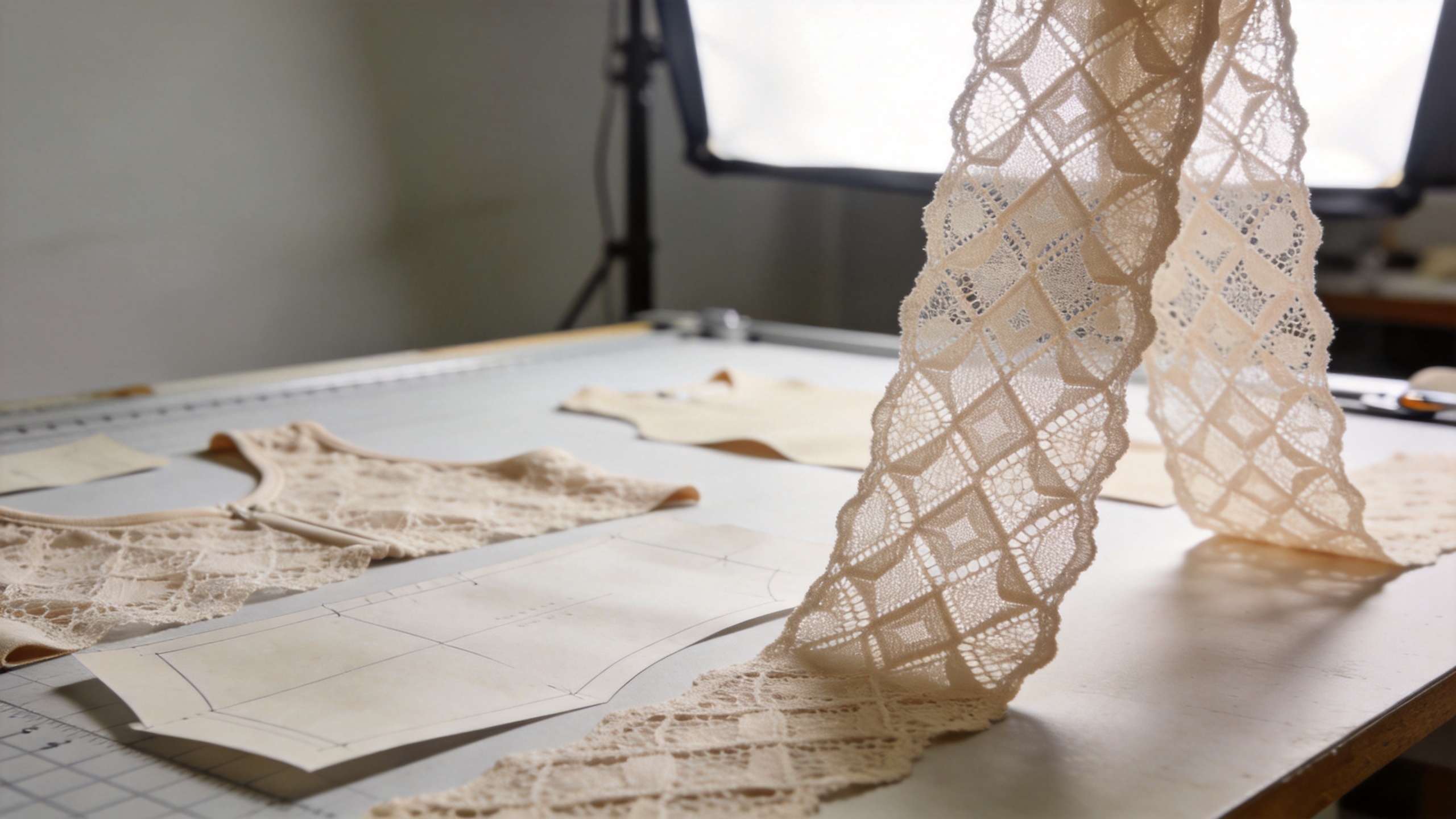
Width affects both design and manufacturability. Search-result references show lingerie trims in a broad range, from narrow edging bands to widths of several inches. That range is useful for early sampling, but it is not a pattern rule. Confirm the usable width after allowing for seam allowance, overlap, scallop placement, and any turn-under operation.
| Design question | What to check on the sample |
|---|---|
| Scalloped edge | Does the scallop remain visible after stitching and stretching? |
| Narrow trim | Can it feed evenly without twisting, rolling, or excessive tension? |
| Wide lace band | Does it cover the intended area without adding unwanted bulk? |
| Motif repeat | Can pattern pieces be placed consistently across sizes and colorways? |
Bring the sewing team into this review early. A beautiful edge can become inefficient if it requires frequent alignment adjustments or if the repeat cannot be positioned consistently at grade points. For production, it is helpful to approve not just a lace swatch but also a sewn sample showing the intended stitch type, seam allowance, and tension setting.
Use sampling to evaluate recovery, color, and lot consistency
For a consideration-stage sourcing decision, sampling is where the specification becomes actionable. Request sufficient material to make a representative garment panel or prototype. Test the lace after stitching, washing according to the intended care route, and repeated extension. Compare color under the same lighting used for shell fabrics and elastics; lace transparency can make a shade appear different once it sits over lining or mesh.
Lot consistency also matters. Ask suppliers how they identify lots, how color approvals are retained, what width tolerance applies, and what information appears on the packing label. If a collection includes multiple colors, approve each colorway with its corresponding companion materials. A trim that matches in a small lab dip can look different after it is layered over a contrast fabric.
Turn supplier communication into a usable purchase brief
A clear brief reduces rounds of vague sampling. Include the finished garment category, the intended placement, target width, preferred stretch direction, required hand feel, color reference, expected order format, and the tests your team will run. Share a marked photo or a small construction sketch when possible. This gives the supplier a better basis for recommending a relevant stretch lace trim option.
For teams seeking a geometric nylon-spandex option, the confirmed product page for Factory Supplier Stretch Lace Nylon Spandex Skin-friendly Geometric Lace can serve as a starting point for a product discussion. Treat the page title as an identification reference; verify width, composition, stretch direction, color, minimum order, and test samples directly before approving it for a production style.
A practical approval checklist
- Confirm the garment zone and the required direction of stretch.
- Verify composition, width, pattern repeat, and usable edge after seam allowance.
- Assess softness and surface behavior against the body-facing materials.
- Run extension-and-recovery checks on both loose lace and sewn samples.
- Review scallop definition, curl, and feeding behavior with the sewing team.
- Approve color with the full garment material stack, not in isolation.
- Document lot, tolerance, labeling, and inspection expectations before bulk ordering.
Stretch lace trim specification matrix
Use this compact matrix to make each stretch lace trim approval point visible to development, quality, and purchasing teams.
| Stretch lace trim control point | Stretch lace trim acceptance question |
|---|---|
| Fiber composition | Is the fiber content documented? |
| Usable width | Does it retain usable width after sewing? |
| Cut direction | Is it cut in the approved direction? |
| Recovery | Does it return after extension? |
| Edge definition | Does the scallop remain defined? |
| Hand feel | Does it feel suitable against skin? |
| Stretch lace trim color | Does the stretch lace trim match companion materials? |
| Stretch lace trim repeat | Can the stretch lace trim motif be placed consistently? |
| Stretch lace trim sewing | Does the stretch lace trim feed cleanly in production? |
| Stretch lace trim lot | Is the stretch lace trim lot traceable on packing labels? |
| Stretch lace trim sample | Has the stretch lace trim been tested on a sewn panel? |
| Stretch lace trim tolerance | Are stretch lace trim tolerances agreed in writing? |
| Stretch lace trim inspection | Is the stretch lace trim inspection method defined? |
| Stretch lace trim packing | Does stretch lace trim packing prevent distortion? |
| Stretch lace trim approval | Is the stretch lace trim approval version recorded? |
| Stretch lace trim reorder | Can the stretch lace trim reference be repeated for bulk orders? |
Final decision: choose for repeatable fit, not appearance alone
The strongest stretch lace trim choice is the one that preserves its visual character while supporting fit and repeatable production. Begin with end use, compare stretch and recovery in the correct direction, and confirm the trim on a sewn sample. When sourcing teams combine these checks with a clear supplier brief, they can make a more confident material decision for lingerie collections and reduce surprises between development and bulk production.