 EN
EN

How to Source Lace Net Fabric for Wholesale Apparel
Buying lace net fabric for a wholesale apparel program is not simply a matter of approving a floral pattern. The same design can behave very differently once it is cut, sewn, dyed, washed, lined, or stretched across a production run. For fashion brands, garment factories, and importers, the right sourcing process turns an attractive swatch into a specification that can be repeated with less uncertainty.
This guide approaches lace net fabric sourcing as a purchasing decision. It focuses on the questions that help a buyer compare options, approve samples, and communicate clearly with a supplier before a bulk order.
Start With the Garment, Not the Swatch
The first decision is where the lace net fabric will sit in the finished garment. A soft, lightweight net may be appropriate for sleeves, overlays, lingerie details, or occasionwear, while a more stable ground may be easier to manage in bodices, skirts, trims, and childrenswear. Ask the product team to define the garment category, whether the fabric will be lined, the intended care method, and the areas that will receive stress during wear.
That context makes technical discussions more useful. Instead of asking for “good-quality lace,” specify the intended end use and request the relevant construction information: fiber content, usable width, weight, stretch direction, base mesh construction, embroidery or decoration method, and any backing or finishing. An open net with a decorative surface is visually appealing, but its suitability depends on how the net, yarn, and motif work together during garment production.
Choose Fiber and Construction for the Required Feel and Performance
Lace net fabric can be made with nylon, polyester, cotton, rayon or viscose components, and blends. Fiber content alone does not determine quality, but it provides a starting point for evaluating hand feel, drape, appearance, recovery, and care expectations. Nylon is often considered when a buyer needs a light, soft base with recovery; polyester can be relevant where color options, visual effects, or cost targets are important; cotton-containing constructions may suit designs seeking a more natural hand.
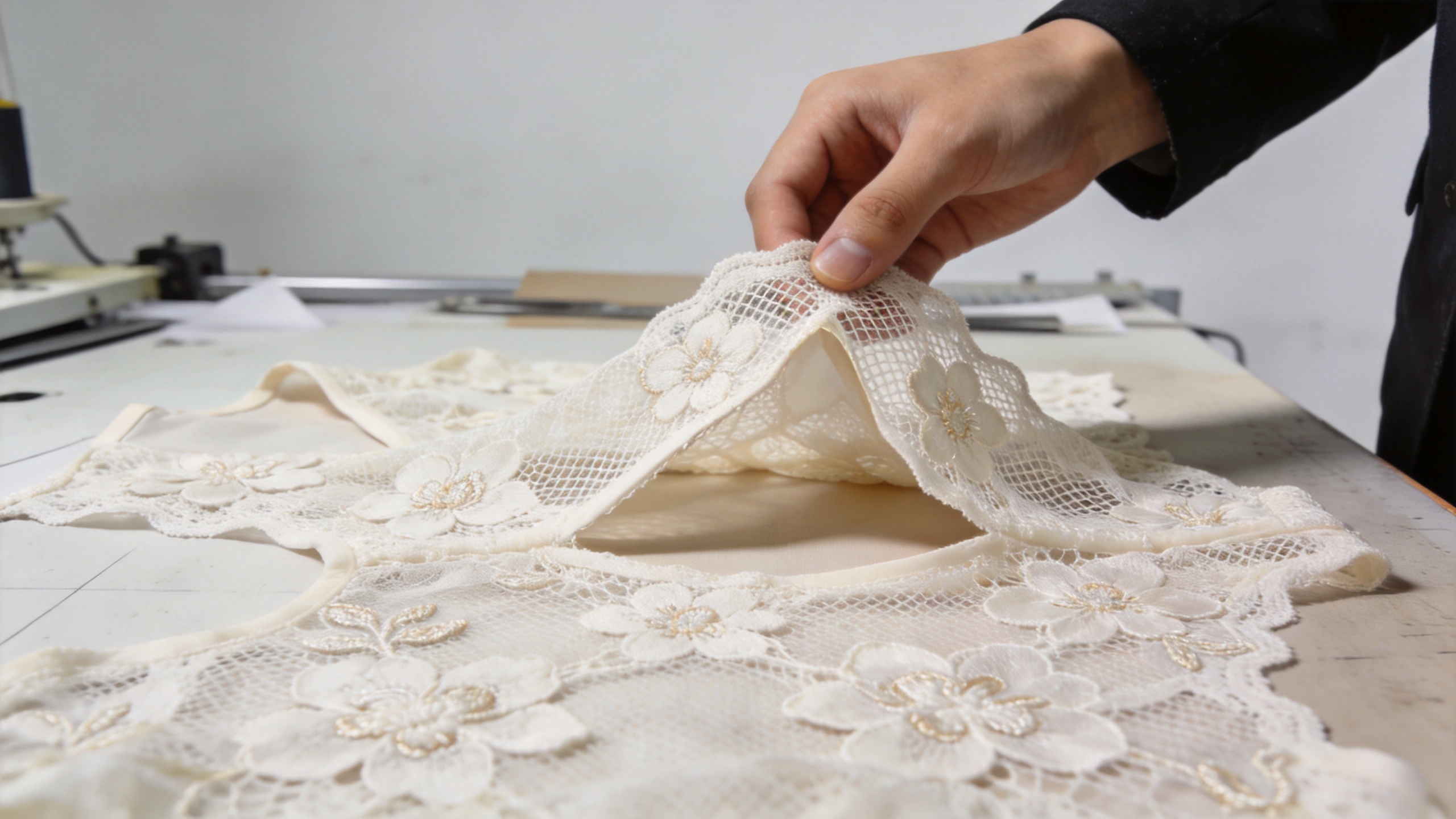
Construction deserves equal attention. Examine the openness and regularity of the net ground, the security of embroidered motifs, and the transition between dense decoration and open areas. If the garment uses a close-fitting silhouette, ask whether stretch is mechanical or comes from elastane content, and test recovery after a controlled extension. For a draped overlay, compare how the fabric falls over the intended lining rather than reviewing it flat on a sample card.
Turn Visual Approval Into a Bulk Specification
A sample can look correct while still leaving essential production details undecided. Before approving a lace net fabric order, document the standard in a purchase specification. A practical file should identify the approved sample or color reference, fiber content, usable width, target weight if available, pattern repeat, stretch direction, base-net appearance, finishing, packaging expectations, and permitted variation for shade or hand feel.
For embroidery, sequins, beads, foil, or other decorative details, the specification should also state the inspection focus. Buyers can request a review of motif placement, loose threads, attachment security, damage in open-net areas, and the appearance of joins or edges. This does not replace a supplier’s own quality process; it gives both parties a common approval point and a clearer basis for reviewing bulk material.
Use a Sampling Workflow That Reflects Production Conditions
For decision-stage sourcing, a staged sample process is usually more informative than a single visual approval. Begin with a swatch to narrow color, pattern, and hand feel. Move to a larger cut when you need to check drape, transparency, cutting behavior, and how the pattern reads at garment scale. Before committing to a larger order, use a pre-production or bulk-lot sample whenever the design, color, finish, or material combination is new to the program.
Test the fabric in the way it will actually be used. Place it over the selected lining, sew a representative seam, and assess whether the open net needs stabilization at stress points. For washable apparel, agree on the relevant wash trial and evaluate changes in appearance, dimensions, color transfer, pilling tendency, or decorative attachment. Record observations with photographs and sample references so that the bulk inspection is tied to an agreed benchmark rather than memory.
Compare Suppliers Beyond Price per Meter
Unit price matters, but it is only one part of the landed and production cost of lace net fabric. A lower-priced option can create avoidable loss if usable width is inconsistent, colors cannot be repeated, defect allowances are unclear, or the material performs poorly during cutting and sewing. Compare quotations on the same basis: composition, width, pattern, finish, order quantity, color method, sampling lead time, bulk lead time, packing, and the process for handling approved quality standards.
It is also useful to ask how the supplier will identify lots and manage continuity. For seasonal fashion programs, request clarity about whether a design is stock-supported, made to order, or subject to yarn and dye availability. The answer helps the buying team decide how much time to reserve for color approval and whether a backup option is needed.
Assess a Confirmed Product Page Carefully
Where a sourcing conversation needs a reference point, buyers can review the confirmed New Style Fashion Nylon Cotton Mesh Lace Fabric listing alongside their own garment requirements. The product title identifies a nylon-cotton mesh lace construction, but buyers should still confirm the current specification, color availability, sample status, and suitability for the intended apparel use before placing an order. A product page is a starting point for discussion, not a substitute for an approved bulk standard.
Questions to Put on Every Lace Net Fabric Inquiry
Using the same questionnaire for each lace net fabric quotation makes comparison faster and reduces missed details. Ask the supplier to answer each point against the offered lace net fabric sample and identify any value that may vary by color or production lot.
| For the lace net fabric | Buyer question | Why it matters |
|---|---|---|
| Lace net fabric composition | What are the declared fibers and proportions? | Supports care, hand-feel, and lining decisions. |
| Lace net fabric width | What is the usable width after edge allowance? | Improves marker and yield planning. |
| Lace net fabric weight | What is the reference weight and tolerance? | Helps compare drape across options. |
| Lace net fabric stretch | Which direction stretches and how does it recover? | Relevant for fit and sewing method. |
| Lace net fabric ground | Is the base mesh stable enough for the garment panel? | Flags reinforcement needs early. |
| Lace net fabric motif | What is the repeat and how should panels be placed? | Helps plan pattern matching. |
| Lace net fabric color | How will the approved shade be referenced? | Creates a traceable bulk standard. |
| Lace net fabric finish | Are softening, stiffening, or coating treatments applied? | Prevents hand-feel surprises. |
| Lace net fabric decoration | How are embroidery or attachments checked? | Defines inspection priorities. |
| Lace net fabric samples | Which sample represents the bulk order? | Connects approval to production. |
| Lace net fabric lots | How will lot identity and shade continuity be handled? | Supports repeat ordering. |
| Lace net fabric packing | How will rolls be packed to protect open areas? | Reduces transit damage risk. |
These questions are not intended to impose a universal specification. They help the buyer translate a design brief into a comparable lace net fabric approval record. When a change is proposed, update the record and review the revised lace net fabric before releasing bulk production.
Wholesale Lace Net Fabric Purchase Checklist
- Define the garment use, lining plan, care expectation, and stress areas.
- Confirm fiber content, usable width, weight where applicable, net construction, stretch, and finish.
- Approve the pattern and color against a labeled physical reference.
- Review a larger cut or pre-production sample under realistic cutting, sewing, and wash conditions.
- Set inspection points for open-net damage, shade variation, motifs, threads, and decorative attachments.
- Compare lead time, lot identification, packaging, and quality-resolution procedures alongside price.
Make the Order Easier to Repeat
A reliable lace net fabric sourcing outcome is a repeatable approval system: a clear end-use brief, an agreed sample, a written specification, and an inspection plan that matches the garment. This approach helps wholesale apparel buyers protect both design intent and production efficiency. By confirming construction and performance early, a team can make a more confident choice without relying on appearance alone.